Warm minimalism vs cold minimalism: the same room, two completely different lives
Walk into a cold minimalist living room and you'll notice something strange: you don't want to sit down. Everything is perfect. The white sofa has no creases. The coffee table holds one ceramic bowl and nothing else. And yet you hover near the doorway, hands in your pockets, like a guest who arrived too early.
Two rooms can follow the exact same rules—few objects, clean lines, no clutter—and still feel like opposite planets. That's the whole warm minimalism versus cold minimalism divide in one sentence. It isn't about how much stuff you own. It's about whether the room invites your body in or keeps it at arm's length.
I've furnished both. I've lived in a cold minimalist apartment that looked stunning in photos and miserable at 9pm in November, and I've slowly rebuilt it into something warm without buying a single new sofa. The difference had almost nothing to do with the furniture. It was temperature, texture, and light—the three things nobody tells you about.
Key Takeaways
- Warm and cold minimalism share the same philosophy (less, intentional, functional)—they differ in materials, color temperature, and texture.
- Cold minimalism reads as sterile mainly because of hard surfaces and cool light, not because of white walls.
- You can warm up a room without replacing furniture: swap lighting, add wood, layer textiles.
- Cold minimalism is still the right call in some cases—small rentals, hot climates, resale-focused properties.
- The transition can be done in stages; the biggest single upgrade is usually lighting, not decor.
The real line between warm minimalism and cold minimalism
Both styles are minimalist. Both say no to clutter. The split happens in the material and light choices that fill the emptiness left behind.
Cold minimalism leans on white, gray, black, glass, polished metal, and lacquer. Surfaces are smooth and reflective. Lighting tends to be cool and even—think recessed LEDs at 4000K or higher, which is roughly the color of an overcast sky. The look is gallery-like. And that's the point: it treats the room as a frame, not a place to rest.
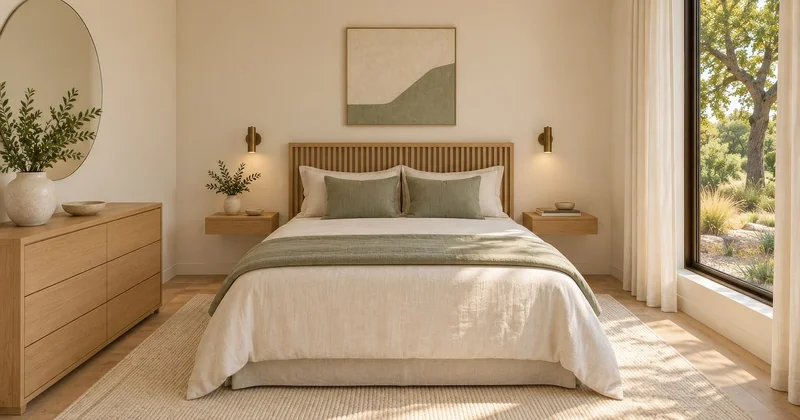
Warm minimalism keeps the restraint but changes the palette. Wood instead of chrome. Linen instead of leather. Matte instead of glossy. Light in the 2700–3000K range—the warm end of the scale, close to the color of an old incandescent bulb. Off-white, cream, clay, oatmeal, and brown replace pure white.
Why color temperature does most of the heavy lifting
Here's something I learned the hard way. I once spent a weekend restyling a client's living room—new cushions, a wool throw, a wooden tray. It looked warmer in daylight. Then evening came, the ceiling LEDs kicked on, and all my work vanished. The room went cold again in about four seconds.
Light temperature beats decor. A 4000K bulb will flatten wood, wool, and linen into the same gray. A 2700K bulb makes even a bare white wall feel soft. If you change one thing this month, change your bulbs, not your furniture.
A quick side-by-side
| Element | Cold minimalism | Warm minimalism |
|---|---|---|
| Dominant palette | White, gray, black | Off-white, cream, clay, brown, oatmeal |
| Main materials | Glass, chrome, lacquer, polished stone | Oak, walnut, linen, wool, matte ceramic |
| Light temperature | 3500–4500K (cool to neutral) | 2700–3000K (warm) |
| Surface finish | Glossy, reflective | Matte, tactile |
| Feeling it creates | Precise, architectural, distant | Calm, lived-in, relaxed |
| Best fit | Bright open lofts, hot climates, rentals | Apartments with limited daylight, family homes, bedrooms |
Why cold minimalism started feeling dated
Cold minimalism had a long run. For well over a decade it was the default look of high-end interiors—the white cube, the concrete floor, the single sculptural chair. It photographed beautifully, which mattered enormously once interiors started living on screens.
Then people actually moved into those rooms.
The problem with a purely cold space is that it offers nothing to touch. There's no texture to rest your eye on, no softness to sink into. After a few months, it doesn't read as intentional. It reads as unfinished—like you're still waiting for the rest of the furniture to arrive.
Warm minimalism answered that directly. Same restraint, same discipline about objects, but with materials that absorb light instead of bouncing it back. And the 2026 palette makes the shift obvious: brown is everywhere—chocolate, espresso, camel. A color that cold minimalism once treated as a mistake is now the anchor of the whole look.
It's not about adding stuff
This is where people get confused. Warm minimalism is not "minimalism plus a lot of plants and blankets." Add too much and you land in maximalism, not warm minimalism. The discipline stays. You still edit ruthlessly. You just choose objects that carry warmth: a chunky wool throw instead of a synthetic one, a solid oak stool instead of a chrome one, a linen curtain instead of a roller blind.
Fewer things, warmer things. That's the whole trick.
Want to know which one is right for your home? Keep reading—there's a section on the cases where cold minimalism still wins.
Warm minimalism vs cold minimalism, room by room
Living room
The living room is where the difference shows fastest. A cold version typically pairs a low white sofa, a glass or metal coffee table, and a large area rug in flat gray. It's balanced and it's cold.
To warm it without redesigning anything, I'd do this in order:
- Swap the rug for wool or jute in a warm neutral—this alone changes the acoustics and the feel underfoot
- Replace the glass table with wood; matte finish, no high gloss
- Add one textured throw and two cushions in different weaves, not matching sets
- Change the bulbs to 2700K
- Add a second light source at low height—a floor lamp near the sofa
The lamp matters more than people expect. A single ceiling light makes any minimal room feel institutional. Two or three light sources at different heights make it feel inhabited.
Kitchen
Kitchens are where cold minimalism has real structural advantages, and I'll say that plainly. Glossy white cabinets and stainless steel are easy to wipe down. Matte wood and open shelving collect grease. If you cook daily, that's not a small thing.
The warm version of a modern kitchen doesn't have to abandon practicality. Choose matte-finish fronts in a warm neutral instead of high-gloss white. Keep stainless appliances, but frame them with wood. Handles in brushed brass or matte black rather than polished chrome. And skip the pure white countertop—an off-white or warm stone reads softer under the same light.
Bedroom
In a bedroom, cold minimalism is close to self-defeating. This is the room where you're supposed to wind down, and a high-contrast white-and-gray palette with cool overhead lighting does the opposite. Warm minimalism is almost always the better call here: layered bedding in washed linen or cotton, wood on the nightstands, dimmable lighting at eye level instead of above your head, and a rug that reaches past the bed on both sides.
Exterior
Outside, the same logic applies but the materials change. A cold exterior—white render, gray paving, black metal—looks sharp and unforgiving. A warm one uses timber cladding, warmer stone tones, and planting that softens the geometry. In hot climates the cold version has a real advantage: white surfaces reflect heat and stay cooler. In northern climates, warm materials and darker tones absorb light and feel more sheltering.
Common questions about minimalism, answered
What is the 30/30 rule for minimalists?
The 30/30 rule is a decluttering habit: each day, you find 30 items to remove and spend 30 minutes doing it. It's a way to keep momentum on days when a full clear-out feels overwhelming. The number isn't magic—the point is a fixed, small target that you can hit even on a busy Tuesday. Done consistently, it adds up fast: thirty items a day for a month is nine hundred things out of your home.
What is the 3-5-7 rule in interior design?
The 3-5-7 rule is a styling guideline for arranging objects, usually on a shelf, mantel, or coffee table. It suggests grouping items in odd numbers—three, five, or seven—because odd groupings tend to look more natural than even ones. The classic version also mixes heights and shapes within the group. Treat it as a starting point, not a law. Three well-chosen objects beat seven random ones every time, and in true minimalism, three is usually where you stop.
Is Elon Musk a minimalist?
Publicly, yes—with caveats. Musk has said he sold most of his houses, and he's described living in a small prefabricated home in Texas, reportedly around 400 square feet. That's a stripped-back, low-possession lifestyle. Whether it counts as "minimalism" in the design sense is another matter: owning few things and decorating a home with intention are different projects. Minimalist living is about how much you keep. Minimalist design is about what you choose to look at. Musk does the first; there's not much evidence he's invested in the second.
What do minimalists throw away every week?
Most of what leaves a minimalist home isn't dramatic. It's the recurring stuff: paper that arrives by mail, duplicates of things you already own, clothes that no longer fit or get worn, packaging, cables with no matching device, expired food, and the small objects that live on surfaces just because no one decided where they belong. The weekly habit is less about big purges and more about never letting clutter settle back in.
When cold minimalism is actually the right choice
I've argued hard for warmth, so let me be fair to the other side. There are situations where cold minimalism works better, and pretending otherwise would be dishonest.
- Small rentals. If you can't paint, can't drill, and move every two years, a cool neutral base is forgiving and portable. Warmth is easier to add with a rug and two lamps than to remove from a landlord's brown kitchen.
- Hot climates. Light, reflective surfaces genuinely keep rooms cooler. In a Mediterranean summer, white walls and stone floors aren't a style choice—they're climate control.
- Rooms with too much light. A south-facing room flooded with warm afternoon sun can tip into orange if you add more warmth. Cool tones balance it.
- Resale. Cool neutrals are the safer bet when you're selling. Buyers project themselves onto white walls; they argue with brown ones.
- Very small rooms. High-contrast cool palettes can make a cramped space read as sharper and more deliberate.
None of this means cold minimalism is the better style. It means it's a tool, and tools have jobs they do well.
How to shift from cold to warm without starting over
You don't need to replace furniture. You need to change what the room is made of.
Start with light. Swap every bulb to 2700K and add one floor lamp. Cost: minimal. Impact: immediate, and I mean visible in the same evening.
Then texture. Add one wool or linen textile where you sit—throw, cushions, or rug. One is enough to start. Notice how the room changes, then decide if you want more.
Then the surfaces you touch daily. If the coffee table is glass and you hate it, that's your next purchase, not a new sofa. Wood, matte finish, nothing shiny.
Then finish. Warm metals instead of chrome. Off-white curtains instead of pure white. A wooden tray to corral the remote and the mug.
The mistake I made early on was doing all of it in one weekend. I bought everything at once, and the result felt like a showroom—warm on paper, empty in practice. Do it in stages, live with each change for a week, and let the room tell you what it still needs. It usually needs less than you think.
And if you get it wrong? Return the cushions. Nobody's grading you.
The real question isn't which style is trending. It's whether the room you come home to makes you want to take your shoes off and stay. Everything else is just catalog copy.